Don Bosco: Biography, Educational Philosophy
Discernment and Foresight
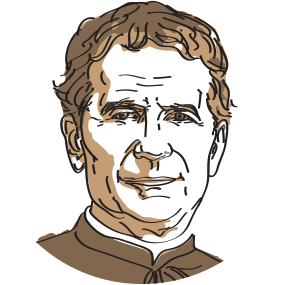
A priest and an outstanding educator, he devoted himself to the youth of Turin; for him, education was a matter of joyful trust and watchful freedom. The first to combine intellectual and vocational training to prevent delinquency, he revolutionized the pedagogy of his time! The Salesian schools found today throughout the world are his legacy. A man of loving and mystical disposition, Don Bosco was also a man of deep prayer who could read hearts. His discernment made him the patron of youth; Heaven would make him its messenger during times of persecution against the Church. On May 30, 1862, he received the famous vision of the Three Whites to save Christendom: the Eucharist, the Immaculate Conception, and the Pope.
(Find more saints in the guide to the saints on Hozana)
The Biography of Don Bosco
A Love Dedicated to Youth
Giovanni Melchior Bosco, or John Bosco, was born on August 16, 1815, in the province of Asti, near Turin. Coming from a very humble peasant background, he grew up on his parents’ farm. Even then, he displayed great charisma and a strong spiritual calling: inspired by the Virgin Mary, John gathered and united other children his age in prayer, entertaining them with tricks and sermons. He was called to enter the priesthood and worked hard to finance his studies, developing various skills along the way (carpentry, shoemaking, etc.). He was ordained a priest in 1841 and would later become known as“Don Bosco.”
Industrialization brought with it certain hardships for the population. It was against this backdrop that the city of Turin, where Don Bosco served, saw poverty and destitution grow in its neighborhoods, particularly among the youngest residents. They were abandoned, starving, neglected—some already criminals, others on the path to becoming so… Deeply moved by the plight of these young people, John Bosco decided to take action: his encounter with a young street child would prove to be a decisive moment in the young priest’s life. One day in December 1841, Barthélemy Garelli, a 16-year-old bricklayer, entered the Church of St. Francis of Assisi. The sacristan quickly chased him out with a broom, but John Bosco, having heard the altercation, went after him to comfort him. The priest learned that Barthélemy was illiterate and an orphan. Don Bosco then took him under his wing to teach him the catechism. Barthélemy then brought his friends back to receive instruction from the priest. Saint John Bosco then founded his first oratory in the Valdocco neighborhood, where he opened a school and youth center with his mother in 1846: there, the children found refuge and an education. His work continued to grow over the years, and John Bosco gave his young people and other members of the organization the name “Salesians,” in honor of Saint Francis de Sales.
The Conversion of Hearts
This work of adaptation was not limited to young people, for the holy priest’s initiative did not sit well with everyone. Indeed, some residents of Turin did not view the children with the same benevolence as Don Bosco and were suspicious of the clergy. Don Bosco’s motives aroused suspicion among the population. The priest was even the target of assassination attempts! In 1854, a cholera epidemic broke out in the city of Turin. The infection spread rapidly, and the city was soon overwhelmed. Don Bosco and his Salesians volunteered to assist the sick, their families, and hospital staff. Impressed by the incredible dedication of these young people, the city then realized the full value and importance of Don Bosco’s teachings.
In December 1859, Don Bosco founded the Society of St. Francis de Sales with 17 of his young people. He continued to expand his work by founding, together with Mother Mazzarello, the Salesian Sisters, “Daughters of Mary Help of Christians,” in 1872. He went on to establish numerous associations, such as the Union of Salesian Cooperators in 1875, which brought together all those—laypeople and religious alike—who wished to commit themselves to the education of young people and to improving their living conditions. The international expansion of his initiative began in France and Latin America before spreading throughout the world.
After many years of dedication and love for young people, Don Bosco passed away in Turin on January 31, 1888. In 1934, Pope Pius XI proclaimed him a saint. One hundred years after his death, John Paul II honored him by declaring him the Father and Teacher of Youth.
The work of Saint John Bosco has left its mark on the world. In Paris, there is the Church of Saint John Bosco, dedicated to the founder of the Salesians.
Don Bosco’s Pedagogy and Legacy
“Pedagogy rests entirely on affection, on charity; that charity described by Paul in his Epistle to the Corinthians: ‘Charity is patient, bears all things, hopes all things.’” — Saint John Bosco.
Saint John Bosco’s deeply humanistic and loving vision earned him the admiration of the young people to whom he devoted his full attention and service. His goal was always to help the most disadvantaged get back on their feet, offering them trust, patience, and love rather than condemning or punishing them. Thus, the education of children must always be accompanied by affection and kindness: it is not enough to love; the young person must feel loved.
At first, the holy priest’s charm allowed him to make a lasting impression: the young people—wary and “shy,” having been rejected for too long—allowed Don Bosco to approach them because he had a gift for conversation and humor. Saint John Bosco is the patron saint of magicians, for he himself performed tricks and illusions to attract these crowds of young people!
Furthermore, the educational system within Don Bosco’s schools gives young people the opportunity for a future, as it trains them in practical vocational skills: carpentry, printing, shoemaking, and so many other craft activities necessary in an era of rapid industrialization. This trust in youth builds social foundations and fosters responsible citizens: the Salesians clearly demonstrated this through their commitment during the 1954 epidemic.
Today, the work of Saint Don Bosco continues to grow even after his death. In our time, the Salesian network continues to operate through a network of schools, social institutions, and youth centers to assist and welcome young people in need, and to help them build plans for their lives. Furthermore, many organizations dedicated to the protection of youth take their name from the Holy Father.
The Hozana editorial team.