What are the rules and practices during Lent?
More and more Christians want to live the Lenten season, but don't necessarily know how. The practice of Lent may be ancient, but the way it is practiced has evolved over the centuries. This period of 40 days before Easter is often associated with a time of fasting and abstinence, but in reality, many questions can arise:
What foods are allowed and what are forbidden?
What are we allowed to do during Lent?
What practices must be respected?
Lent is above all a posture of the heart, a desire to encounter Jesus. It's more a question of choices made and lived in conscience than of obligations or rituals to be respected. Nevertheless, the Church gives us some advice and invites us to make a special effort, so that we can live this time of penitence in depth, with just one aim: to fully welcome the joy of the resurrection!
To begin with, a few key points to know about Lent
Lent is a period of fasting and prayer for Christians in preparation for Easter, the feast of Christ's Resurrection.
- Lent lasts 40 days and returns every year.(Find the dates of Lent 2026)
- Lent begins on Ash Wednesday and ends on Easter Day.
- Holy Week - the week leading up to Easter - is a highlight of this period.
- Sundays are considered "out of Lent". Every Sunday in Lent, fasting and abstinence come to an end.
- You don't have to be baptized to take part in Lent.
- There is no age limit for Lent, but efforts must be adapted to each person's age and physical condition.
- There are no formal prohibitions, just a spirit of sharing and penance.
- Lent is both a personal process (lived in the intimacy of one's heart) and a communal one (with times for sharing in the Church).
The three pillars of Lent: 3 ways to get closer to Christ
To define what' s expected of a Christian during Lent, we can think of the 3 P's: Prayer, Penance and Sharing. These three words remind us that this period is an invitation to interiority: to return to God, to detach ourselves from what clutters us, to refocus on what's essential... but also to be open to others: to be compassionate, to help each other, to listen...
It's 40 days to rediscover simplicity, cultivate humility and make more room for God in our daily lives.
Here are a few practical tips to help you do just that!
Prayer
Lent is a privileged time to develop our practice of prayer.
Personal prayer: each person, according to his or her practice and habits, can decide on a reasonable action to take during 40 days to pray a little more.
- For those who don't pray - or don't pray every day - this could be by setting aside a daily prayer timein the morning or evening. For example, by reciting the Our Father.
- For those who already pray every day, it can be by completing this prayer time with the reading and meditation of the day's Gospel, or by reciting a decade of the Rosary.
- By choosing a spiritual journey for Easter, with daily prayers and meditations (on Hozana, you'll find , to accompany you throughout Lent).
Community prayer The Lenten season, shared by Catholics the world over, reminds us that we are all in communion with one another, through and in Christ. So it's important to spend time praying together, especially by going to Church for the important Lenten celebrations: Ash Wednesday, Palm Sunday, Sunday Masses... and, if possible, Holy Week celebrations.
Fasting
Closely associated with Lent, the practice of fasting can raise many questions, and even be a little scary. And yet, it is above all an act of love, and should be lived as such.
It is not a question of prohibitions or deprivations experienced as obligations, but of a desire to lighten up and detach ourselves from our material preoccupations in order to put Jesus at the center of our lives. Each of us can take the time to discern what type of fast would be the most beautiful offering to make to Jesus. Here are a few examples:
Food fasting :
- Observe the Church's recommendations for fasting:
1 "every Friday, they must abstain from meat if they can" ;
2 "on Ash Wednesday, the day on which Lent begins, and on Good Friday, the day of the Savior's death, they are to abstain from meat, they are to fast by substantially depriving themselves of food according to their age and strength, and reserve a notable amount of time for prayer."(Decree of the Conférence des évêques de France concerning canons 1251 and 1253) - Choosing a food to deprive oneself of during Lent (excluding Sundays), particularly those with addictive potential and which therefore hinder our freedom: this could be alcohol, sweets or coffee, for example. Cigarettes can also be part of this (see tips for adopting a healthy dietary asceticism).
Digital fasting :
- Stop or limit your use of social networks
- Limit screen time or stop certain time-consuming and/or harmful uses (TV series, video games, pornography, etc.) (Find out why and how to practice digital asceticism).
Other types of fasting :
- Decide not to buy new clothes / new games / new non-essential objects ... during this period
- Try not to criticize or use foul language during this period
- ...
- (Find the types of fasting recommended by Pope Francis for a beautiful Lent!)
Three tips for fasting well:
- There's no point in choosing a fast that's too strict and that you won't be able to keep; it's better to choose a well-defined and circumscribed action that you'll be able to keep over time. There's no such thing as a "small fast"!
- Don't get discouraged! Falling down is part of the journey. The important thing is to get back up and start again. I broke down and ate a whole bar of chocolate today? I couldn't stop myself from scrolling for hours on social networks this week? That's okay. I offer this to Jesus and decide to resume my fast for the time being.
- Go to confession at least once during this period. Thesacrament of reconciliation helps us to live through this period by humbly presenting to God the wounds, fears and attitudes that prevent us from truly loving. We emerge lighter and stronger to clean up our "bad" habits!
Sharing
Prayer and fasting help us to turn towards God. But to truly love God, we need to love our neighbor: "This is the commandment we have from him: whoever loves God must also love his brother." (1 John 4:21).
And this is done through concrete acts of charity and sharing.
It's up to us to define how we can be more attentive and put ourselves at the service of those in need. It's a good thing we've saved time and/or money through our fasting actions, which we can then use for others!
Here are a few ideas for Lenten actions:
- Make a donation to an association that cares for the poor or suffering
- Decide to visit or call someone you know who is very lonely.
- Find a volunteer project to carry out in our city
- Stop to exchange a few words with the homeless person we pass every morning
- Take a little more time to listen attentively and kindly to those who need to talk: the colleague, the friend, the neighbor, the spouse, the aging parent...
Live Lent to the fullest with Hozana
On the Hozana website or app, find numerous suggestions for and discover Lenten journeys that have been followed by thousands of prayers, such as :
- From Palm Sunday to Easter, let us by praying with the heart of Mary.
- Join this community to experience the extraordinary " and enter with him into the joy of Easter.
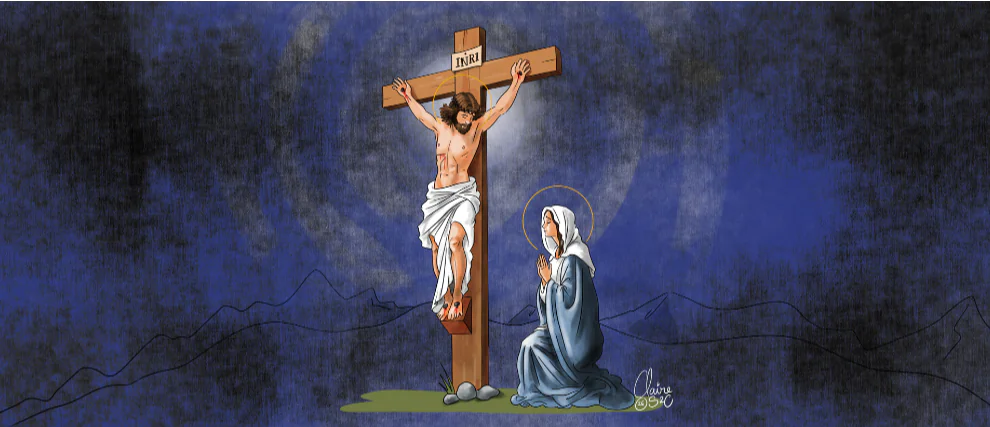
Holy Week as seen from the heart of Mary
Lent: Frequently asked questions
What is the forbidden word during Lent?
During Lent, there are no alleluia or gloria during liturgical celebrations. This underlines the fact that this is a time of penitence. These words of praise are held in expectation of Easter, a feast day when Christians let their joy explode.
Can I drink during Lent?
There are no formal prohibitions on alcohol during Lent. However, this period invites everyone to be temperate and sober in the way they consume. Limiting or stopping alcohol consumption is therefore a fine effort that can be made during Lent, or at least during the two days of fasting recommended by the Church: Ash Wednesday and Good Friday.
What are the 3 pillars of Lent?
The 3 pillars of Lent are : Prayer, Penance (Fasting), Sharing (Almsgiving).
What are the times for Christian fasting?
Christian fasting during Lent has no set timetable. It's a partial fast (no more than one type of food) that is practiced over the 40 days of Lent (excluding Sundays), and can be intensified on two special days during the period: Ash Wednesday (entry into Lent) and Good Friday (commemoration of Christ's death).
What are the dates for Lent 2026?
In 2026, Lent will begin on Wednesday, February 18 and end on Easter Sunday, April 5.