Guide to Christian Meditation
Today, more and more of us are looking for peace and inner calm in a world where stress, worry and incessant demands attack and weaken us. The development and democratization of meditative practices is one response to this desire for relaxation and well-being: Yoga, mindfulness meditation , transcendental meditation , sophrology... But simple relaxation is often not enough to satisfy this need for refocusing, which generally reflects a profound need for interiority, a deep longing for God. Christian meditation, which has been part of a long meditative and contemplative tradition for over 2000 years, is above all a form of prayer that invites us to make ourselves fully present to the One who, within us, is the source of all peace and joy. It's a journey each of us can take to the heart of ourselves, to meet God, who awaits us there.
Whether you're looking for peace, simplicity and unity in your life, or want to deepen and nourish your relationship with God, who is present in the most intimate part of us, Christian meditation can offer you a real path to joy!
Discover Christian meditation
We might ask ourselves what is so special about Christian meditation compared to other meditation practices, such as mindfulness meditation, whether secular or derived from other spiritualities (Eastern meditation).
Certainly, there are points in common between Christian meditation and other types of meditation, notably :
- the invitation to "go within" and discover our inner life, particularly through silence
- a calming of thoughts and mental agitation
- anchoring us in the present moment
But Christian meditation is not a relaxation technique, a wellness practice or a personal development tool; its heart and purpose remain, above all, the relationship with God, which makes it profound and specific.
Origins: Christian monasticism
Christian meditation is based on a set of practices that can be divided into two main trends: meditation on the Word of God, such as lectio divina, Ignatian meditation ormeditation on the Gospels with the rosary, and silent , contemplative prayer, such as recollected prayer or the Jesus Prayer.
These different practices have emerged over the centuries, developed and carried forward by various great Christian spiritual figures: the Desert Fathers, Saint Teresa of Avila, Saint Ignatius of Loyola... and still widely practiced to this day in the various monastic orders.
By praying, contemplating Jesus and seeking ever closer contact with God, these hermits and nuns developed and enriched their meditative practices. While they may differ in form, they all have the same goal and the same object: God.
The goal: a heart-to-heart encounter with the God who dwells within us
Christian meditation is not simply a technique or method for achieving a particular state of well-being. It is a living relationship with God, Father, Son and Holy Spirit.
Of course, like all encounters, it transforms us. The intimacy it creates with God opens up paths of healing, liberation, joy and peace. These are gifts from God that meditation helps us to welcome more fully.
Through meditation, we seek above all to place ourselves in the presence of God, through silence and listening to His word. In so doing, they respond to the deep-rooted human desire to return to the source of all life and allow themselves to be fully loved.
Christian meditation: many benefits
If the aim of Christian meditation is to make oneself present to God, there are no fewer benefits for the practitioner. These include :
- spiritual fruits, such as patience, listening, trust, humility and gratitude
but also
- an overall sense of well-being, through the search for unity between body, mind and spirit attention to the body (posture, breathing, sensations, etc.), welcoming our emotions (feelings, state of mind, etc.), and directing our thoughts.
- a fairer, calmer relationship with the world, with others and with everyday events, thanks to a better knowledge and understanding of who we are.
- a profound inner transformation, a metanoia.
Christian meditation is a highly embodied form of prayer, enabling us to reap very concrete benefits for our everyday lives: better sleep, stress management and reduced anxiety, improved self-esteem, ... Evening ormorning, you can meditate at any time of day.
Getting started with Christian meditation
Getting started in meditation
Everyone can meditate(no special skills or prerequisites are required!), but it's important to take some time - adapted to your own needs - to prepare for the moment.
1 - Setting up
There's no specific place, time or posture for Christian meditation. However, establishing a habit and a regularity both in space and in the time we devote to it during the day is an important aid to practice. Establishing an appointment with God already prepares us internally for greater availability.
It's also important to take the time at the start of a session to find the best conditions for relaxation and concentration:
- choose a quiet place where you feel comfortable.
- Find a comfortable position that doesn't make you drowsy : for example, kneeling on a prayer bench or sitting on a chair, as monks traditionally do for silent prayer.
- make sure - as far as possible - not to be disturbed, by switching off the telephone for example.
2 - Time to prepare and make yourself available for prayer
Once we've settled in, we can take a few minutes toanchor ourselves firmly in the here and now. Beyondsimple relaxation, a prior exercise in paying attention to our breathing, our body and our environment enables us to let go of tension and calm our cerebral wanderings, so we can better make ourselves available to God.
3- Putting ourselves in God's presence
Once we've made ourselves present to our bodies and to what we're about to experience, we turn inward to God. He makes himself available and attentive to what he is about to experience in meditation. Making a gesture, such as the sign of the cross, or saying a few words, can help make this opening and entry into meditation more conscious.
The Vittoz method
Christian meditation integrates our entire being: body, heart and mind. The techniques used - visualization, repetition, breathing, etc.- encourage interiorization, helping us to "cut off" from the outside world. The research and discoveries of Dr. Vittoz - a Christian physician of the early 20th century - enabled him to develop a mind-body method that leads us to experience everything more consciously. Through exercises that focus attention on sensations, breathing and our environment, the Vittoz method helps us to reconnect with our entire being and rediscover a sense of unity. These simple exercises are a good prelude to a time of meditation.
Help, advice and support
It's not always easy to start meditating on your own. Questions and doubts may arise. Sometimes you may feel discouraged. All this is normal! (Find all our advice on how to start practicing Christian meditation, as well as a guided session to get you started).
In addition to retreats in monasteries, where you can discover meditative traditions and be accompanied by monks or nuns, there are tools available to support beginners and encourage the more experienced meditator.
Guided Christian meditation for beginners
Here's an example of how to experience a time of meditation with God:
- Before starting the meditation session, it's important to take the time to settle in: find a place that's as quiet as possible, away from distractions, and choose my position carefully.
- Once I'm settled, I let the silence settle in. I can close my eyes if that helps me to go inward. I let my breathing become calmer, my thoughts calmer.
- I take a few deep breaths to help me cut through my inner turmoil. I inhale through my nose, watching my lungs and belly expand as I inhale, and exhale slowly through my mouth, letting my muscles relax as I exhale. I can repeat this two or three times.
- I then let my breathing resume its natural rhythm.
- I take the time to put myself in God's presence. I become aware that he's there, in the silence of my soul, waiting for me, wanting to spend this moment with me. I, too, can tell him of my desire to be with him, for example, by saying "Here I am Lord".
- " (1 Peter 5:7) We read in the Bible, in the first letter of the apostle Peter. I can repeat this verse several times, letting it imprint itself on me.
"Cast all your cares upon him, for he cares for you."
I observe what this word brings out in me. - I can now take a moment to unload all my worries. What's heavy right now, what's worrying me, what's preventing me from moving forward, what I've been carrying around inside me for a long time. I can unload it all. God carries everything I unload onto him.
- I can end with a heart-to-heart time, in silence, with God, trusting that he's taking care of me. Then I close this time of meditation by thanking him for this moment spent with him.
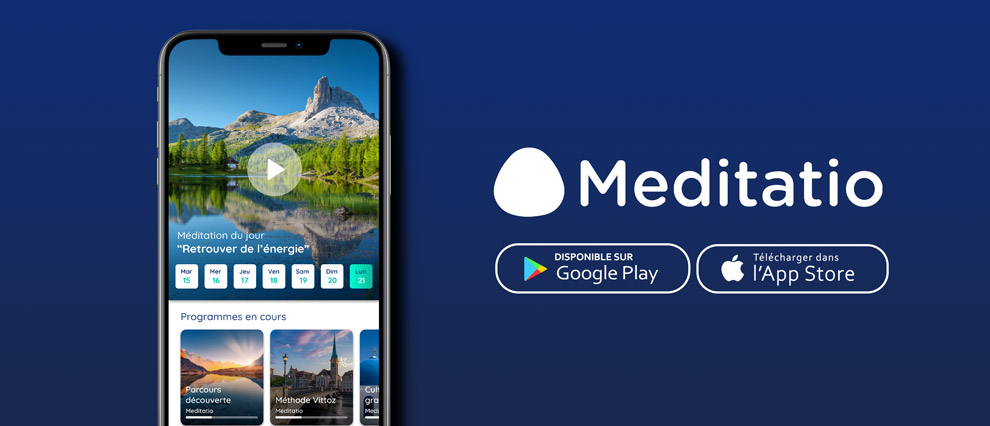
(source: Meditatio)
Christian meditation is just one type of meditation. Find out more about the different forms of meditation.
Learn more about Christian meditation traditions
Our spiritual journey may also give us the desire to delve deeper into one or other of the Christian traditions.
Lectio divina
Lectio divina is a prayerful reading of the Bible organized around 4 stages: lectio, meditatio, oratio and contemplatio. It's a very ancient practice, already present in Jewish tradition. It consists in listening to God through a holy text.
(Find out more about lectio divina and how to practice it, as well asa concrete example of lectio divina. )
The Jesus Prayer
Derived from hesychasm, the Jesus prayer - or prayer of the heart - is the repetition of a short invocation in the name of Jesus. In tune with the breath, the praying person repeats this prayer : "Lord Jesus Christ, Son of God, have mercy on me, a sinner. " or even simply the name of Jesus. This simple form of prayer is nonetheless extremely powerful, helping us to anchor ourselves in God's presence.
(Find out more about these meditative practices from the Orthodox tradition)
Ignatian meditation
In the 15th century, Ignatius of Loyola developed an approach, notably through his spiritual exercises, that invites us to immerse ourselves in the Gospels in a unique and lively way. He invites us to contemplate Jesus, through a Gospel passage, and to let ourselves be touched by him and by what he wants to tell us, for us, today.
(Find out more about the spiritual exercises andan example of meditating on a Gospel using the Ignatian method)
Recollected prayer
Recollected prayer, still very much a part of the Carmelite order, was developed by St. Teresa of Avila, who saw it as a "relationship of friendship with the one we know we love". This silent prayer helps us to enter into ourselves - into our "inner castle" - where God dwells.
(Find out more about silent prayer and how to practice it, and get your first taste of prayer with this guided session).
Contemplation
Contemplation is an attitude and a movement of openness on the part of the Christian who observes and marvels at God's presence, whether through his Word or his creation, for example. Eucharistic adoration is a form of contemplative prayer. Contemplation helps us to see God's beauty, strength, greatness and tenderness.
(Find tips and exercises for practicing the art of contemplation)